Quarterly

Food & Beverage
Market Intelligence Report

Q2 2026

Whitehorn Capital's Food & Beverage Industry Report presents performance trends and transaction activity observed in this sector in Canada and the US. All financial data has been sourced from LSEG Workspace.

Whitehorn Capital Inc.
Corporate Finance & Advisory
www.whitehorncapital.com

Whitehorn's Food & Beverage Industry Report includes companies that manufacture or process bakery & grain products, confectionery, dairy products, frozen foods, meat & seafood, organic foods & produce and prepared & preserved foods products within North America.

Average Industry Revenue Growth chart
Average Gross Profit and EBITDA Margins chart

Key Quarterly Highlights

May 6
Canadian cattle producers are pushing the federal government to omit beef from the free trade agreement between Canada and the Mercosur trade bloc, citing the negative impact on local beef industry.
June 18
HelloFresh's subsidiary, Factor Meals, opens a 50,000 sq ft facility in Calgary consisting of a commercial kitchen and distribution centre to serve Western Canada, with 400 jobs expected to be created.
June 19
The federal government announced a 10% tariff on imported canned vegetables for 200 days. The tariff excludes the U.S., Mexico, Israel, Chile and other developing countries.
June 30
China to impose a 73.5% preliminary tariff on Canadian pea starch imports from July 1 onwards, a temporary anti-dumping measure following a 10-month investigation.
 

Performance Trends by Sector

Average Revenue Growth by sector chart
Average EBITDA Margin by sector chart


Higher Oil, Weaker Loonie. Why the Old Rule Broke.

If your food & beverage business sells into the US or you deal with suppliers south of the border, note the following: the higher oil, higher Loonie relationship doesn't necessarily hold anymore. Instead, it's about the gap between Canadian and US interest rates. We dive deeper into the data below:
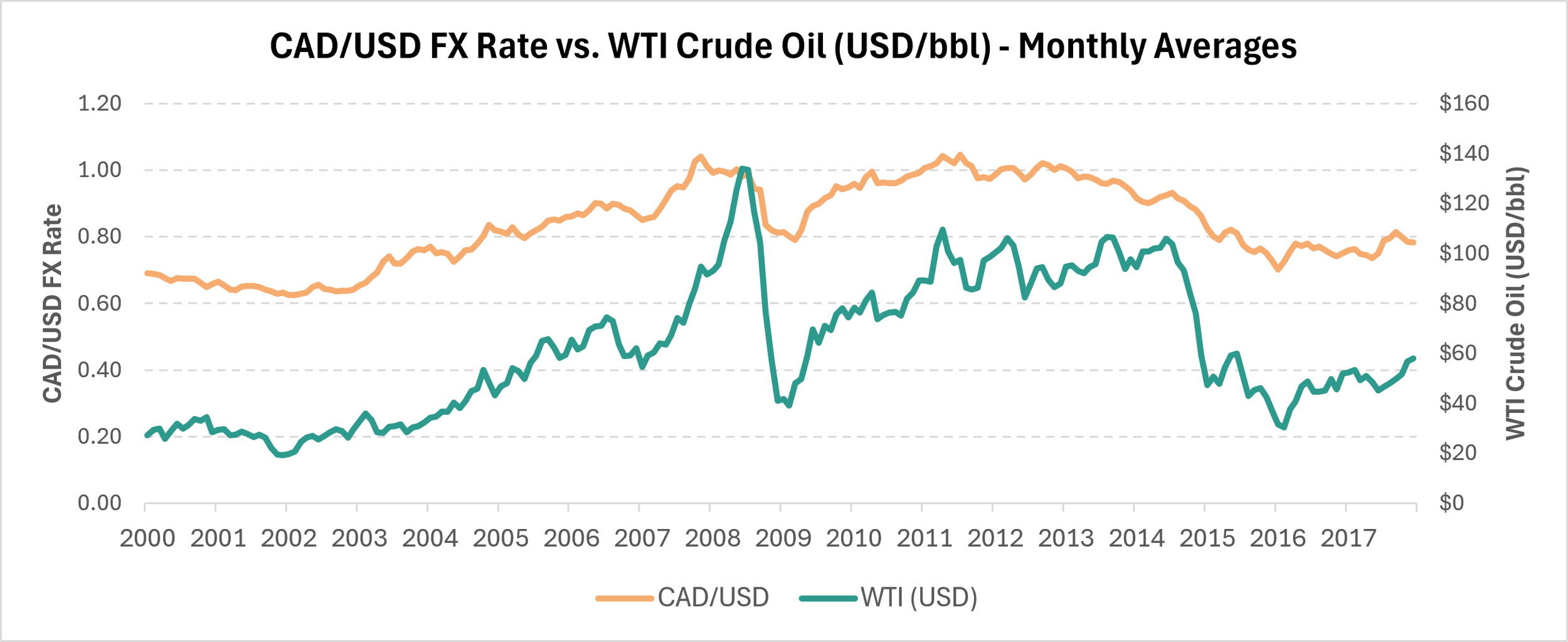
Past: The Loonie Moved with Oil (2000–2017)
CAD/USD FX rate vs. WTI crude oil, monthly averages, 2000-2017
0.9258
Correlation
Jan 2000 – Dec 2017
What does this mean?
Oil up = CAD strong; Oil down = CAD weak
·Historically, the Canadian dollar acted as a prominent commodity currency.
·As crude oil represents a foundational share of our exports to our largest trading partner south of the border, the CAD/USD FX rate was naturally responsive to WTI movements.
·When oil prices rose, a combination of capital inflow to the Canadian energy sector and the demand for Canadian oil would boost CAD demand.
·On the other hand, global oil oversupply or demand collapses, as evident in 2008 and 2014, typically led to a CAD depreciation.

The Split

In the early 2020s, both the Bank of Canada and the Federal Reserve hiked rates in lockstep until 2023. Since Q2 2024, there has been a material divergence in monetary policy between both central banks.

Monthly BofC overnight rate vs. US Fed Funds rate
·The Bank of Canada started cutting rates in June 2024, which signaled the beginning of the divergence.
·The Federal Reserve only began cutting rates in Aug. 2024. In addition, the Bank of Canada reduced rates further compared to its U.S. counterpart since then.
·The current spread between the two nations is 1.50 percentage points.

How a Rate Gap Resulted in a Weaker Loonie

The chain of cause and effect is summarized below.

Step 1
🏦
US Bonds Pay More
A 90-day US T-bill yields ~1.5pp more than the Canadian equivalent. Same risk, better return.
Step 2
💰
Capital Chases Yield
Pension funds, banks, and investors worldwide shift money out of CAD assets into higher-paying USD assets.
Step 3
💱
To Buy US Bonds, Sell CAD First
Every shift requires converting CAD to USD. This selling pressure pushes USD/CAD up directly.
Step 4
📉
CAD Weakens — Even If Oil Rises
Rate-driven capital flows are larger and faster than oil-trade flows, so they dominate currency pricing.
Monthly US-Canada rate spread vs. USD/CAD
0.4682
Correlation
Rate Spread vs. USD/CAD
What does this mean?

Interest rate spread is a better predictor of USD/CAD today than oil prices.

Why Canada Cut Rates Faster than the US

Below, we review three factors behind the divergence:

01
Canadian Economy Cooled Faster
Weaker Canadian GDP and softening labour market as key indicators.
BofC cut rates 9 times between June 2024 and Oct. 2025 for a 275-basis points reduction combined.
02
US Inflation Remained Hotter
Persistent core inflation and tariff-driven price pressure in the U.S. kept the Fed more cautious.
The Fed paused rate cuts for most of 2025 despite pressure from Trump, while Canadian inflation returned to target earlier in 2024.
03
Tariffs Hit Canada Harder
US imposed tariffs weighed heavily on Canadian exports and business investment given high Canadian exposure to the US market.
The BofC was forced to be more accommodating to absorb the economic shock whereas the Fed had less reason to ease aggressively.
Bottom Line for Canadian Food & Beverage Companies

If your business carries USD costs, debt, or receivables, keep an eye out for the BofC-Fed spread when determining your USD exposure. With a rate hike expected in the US in H2 2026 while the BofC maintains status quo, we anticipate the Loonie to perform weaker than the USD for the remainder of 2026.


Select Merger & Acquisition Transactions

Notable Canadian food & beverage transactions in the past quarter.

Date
Acquirer
Acquirer HQ
Target
Target HQ
Apr. 2026
CleanGo Innovations (CSE:CGII)
Woodlands, TX
AgritechBC Solutions
Kelowna, BC
Acquisition of 49% equity stake in provider of agricultural technology to maximize yields and optimize resource management to broaden green solutions and expertise.
Apr. 2026
United Petfood
Belgium
Jupiter production facility
Drummondville, QC
Acquisition of the dry pet food manufacturing facility from Legault Group to enter into dry manufacturing in Canada.
Apr. 2026
UFA Co-operative
Calgary, AB
Assets of AgraCity Crop & Nutrition
Saskatoon, SK
Acquisition of key assets including generic agricultural chemical registrations, a packaging and labelling facility and associated equipment, and a modern fertilizer blender through a SISP under CCAA to expand crop protection and fertilizer capabilities.
Apr. 2026
Mersey Seafoods
Liverpool, NS
Comeau Seafoods
Saulnierville, NS
Acquisition of seafood wholesaler supplying whitefish, shellfish and salmon products.
May 2026
Roskam Foods
Grand Rapids, MI
Kitchen Partners
Edmonton, AB
Acquisition of sauce, marinades, dips, and soups manufacturer to further expand offerings and Canadian presence.
May 2026
TriWest Capital Partners
Calgary, AB
Ocean Brands
Richmond, BC
Acquisition of manufacturer, marketer and distributor of food products including the Ocean's, Gold Seal, Nonna Pia's and Culinary Collective brands.
June 2026
Fairfax Financial Holdings (TSX:FFH)
Toronto, ON
Andrew Peller
Grimsby, ON
$579MM acquisition of wine producer with production facilities in BC, ON and NS.

Check out more transactions on our website.

Subsector
Q2 2026
Q1 2026
Bakery & Grain Mill Products
6
2
Confectionery
9
5
Frozen Foods
3
4
Meats & Seafoods
9
8
Organic Foods & Fresh Produce
5
3
Prepared & Preserved Foods
21
12
Dairy Products
0
3
Total
74
52
-40%
Q2 2026 vs. Q1 2026
-15%
Q2 2026 vs. Q2 2025

Let's talk about
your next move.

Whitehorn Capital provides corporate finance and advisory services to Western Canadian food & beverage companies. To discuss this quarter's findings, reach our team below.

Phone
403 680 4266
Whitehorn Expert
Greg Quinn, CA, CBV
Address
3332 20 St SW Suite 406, Calgary, AB T2T 6S1

All financial data has been sourced from LSEG Workspace. This report is prepared by Whitehorn Capital Inc. for informational purposes only and does not constitute investment, legal, or tax advice. Figures may include forecasts and are subject to change without notice.